
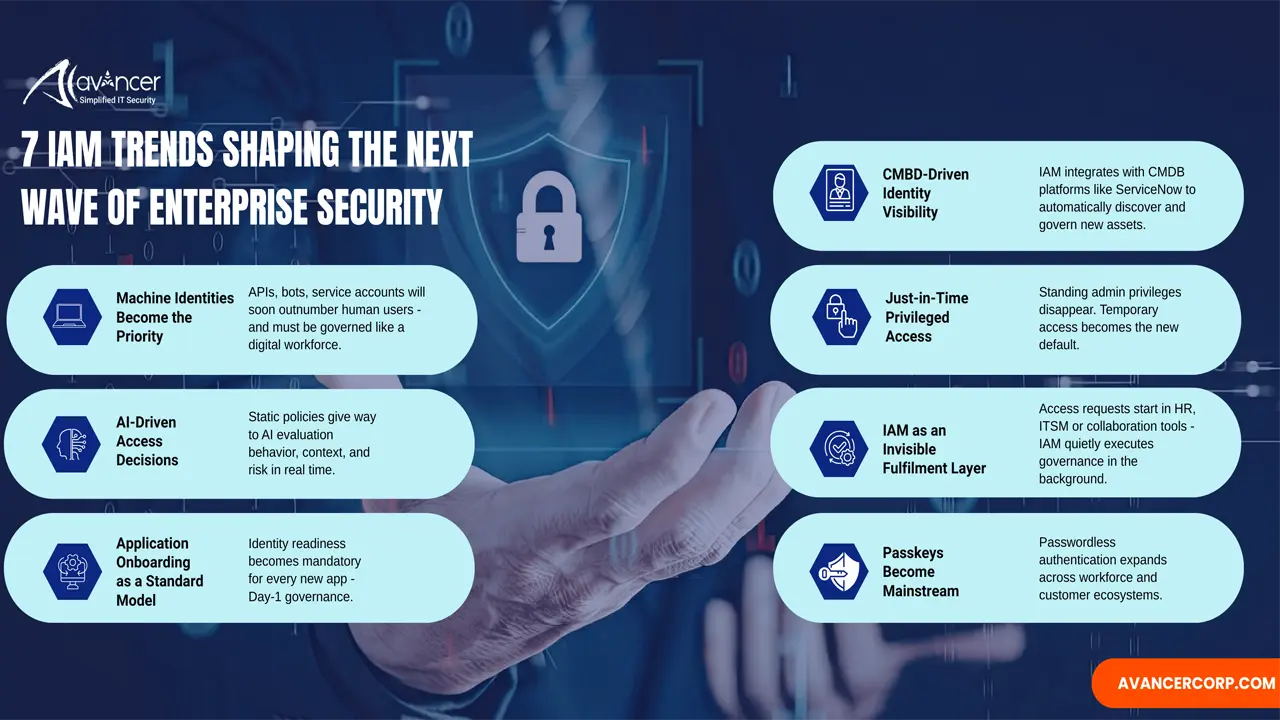
This year, IAM is shifting from traditional gatekeeping to intelligent, embedded fulfilment engines that govern how access is discovered, requested, approved, and continuously enforced. The rise of machine identities, AI-driven access decisions, CMDB-led discovery, and just-in-time (JIT) privilege models is rewriting enterprise security and operations.
These trends are not buzzwords – they are forces reshaping how organizations operate. Companies that prepare early will move faster, remain continuously compliant, and eliminate operational friction. Those that don’t will find identity becoming the bottleneck to scale.
Here are the solution-led shifts at the centre of change – and what companies must do to be ready.
1. Machine identities will become the primary governance priority
Non-human identities – APIs, workloads, bots, service accounts, automation scripts – are multiplying faster than any IAM team can manually track. They will soon represent the largest unmanaged identity risk.
The Solution: Treat machine identities as a digital workforce with defined lifecycle governance.
- Discovery & Inventory: Automate scanning of service accounts, secrets, and keys across cloud and DevOps environments using tools like CloudAware or Spectral.
- Ownership Assignment: Every machine identity must have a named human sponsor. If a bot is created for a marketing automation tool, the Marketing Ops Lead is the owner.
- Lifecycle Policy: Enforce inactivity-based expiry and automated decommissioning. For instance, if a service account is inactive for 30 days, it is automatically disabled.
2. AI-driven identity decisions will replace static policies
Manual rule-building and static access policies cannot scale to modern risk environments. AI-driven decision engines will increasingly determine access based on behavior, context, and real-time risk signals.
The Solution: Shift from AI as a tool to AI as a governed identity.
- Identity-First AI: Assign unique IDs to AI agents for full auditability. This ensures that if an AI agent makes a mistake, the audit log shows exactly which agent did it.
- Human-in-the-Loop (HITL) Triggers: Define human-in-the-loop approvals for high-risk actions (e.g., deleting a database or changing a payroll entry) before the AI can proceed.
3. Application onboarding will become a standard operating model
Enterprises are adopting SaaS platforms, cloud services, and internally built applications at unprecedented speed. What was once treated as a technical integration exercise is rapidly becoming a strategic operating standard. Organizations can no longer afford months-long identity onboarding cycles — delayed integrations directly impact productivity, governance, and risk posture.
The Solution: Shift from reactive integrations to a standardized onboarding framework.
- Standardized Onboarding Contracts: Establish identity readiness requirements for all new applications, mandating support for protocols such as SCIM to ensure Day-1 governance.
- Reusable Integration Patterns: Build repeatable workflows and connector frameworks that allow applications to be onboarded quickly and consistently — reducing dependency on manual IT effort and eliminating bottlenecks.
4. CMDB-driven discovery will become the foundation of identity visibility
You cannot govern access to assets you cannot see. CMDBs like ServiceNow or Flexera are becoming the authoritative system for application and infrastructure inventories — and IAM will plug directly into them.
The Solution: Federate identity governance with asset intelligence.
- Cross-Tool Sync: Trigger identity controls automatically when new assets appear in the CMDB. For instance, when a new server is added to the CMDB, the IAM system should automatically trigger a workflow to secure it.
- Normalization: Standardize role and entitlement naming so equivalent access levels are consistently recognized across all discovery and governance sources.
5. Just-in-Time (JIT) access will become the default privileged model
Persistent privileged access is rapidly becoming indefensible under modern breach and compliance expectations. JIT access models – where elevation is granted only when needed – will become standard.
The Solution: Eliminate standing admin access.
- Transition to JIT: Remove permanent admin rights. When an engineer needs access, they request it “Just-in-Time.” The system creates a temporary session that expires in pre-defined hours.
- Policy-Based Access: Automate approvals for low-risk tasks based on context (e.g., if the user is on the corporate network and it’s during work hours, auto-approve the request).
6. IAM will operate as an invisible fulfilment layer
IAM tools will increasingly disappear from the user’s view. Access requests will originate in HR systems, ITSM platforms, or enterprise portals – while IAM quietly executes provisioning, enforcement, and audit.
The Solution: Bring security to the user’s workflow.
- In-App Requests: Don’t make users go to a security portal. Integrate access requests directly into Slack, MS Teams or ServiceNow.
- Invisible Security: Apply background conditional access without interrupting users. For instance, if everything is safe, the user is never prompted for an extra login step.
7. Passkeys will move from enterprise rollout to everyday user adoption
Passwordless authentication has crossed the experimentation phase and is steadily becoming part of the default user experience. Passkeys are no longer limited to controlled enterprise deployments — they are expanding to normal users across workforce and customer ecosystems, signaling a broader shift toward phishing-resistant, user-friendly authentication.
The Solution: Prepare for authentication at consumer scale.
- Prioritize High-Impact Use Cases: Begin with user groups and access journeys where passwords pose the highest risk or friction, then expand systematically toward wider adoption.
- Enforce Device Trust: Anchor passkeys to trusted devices and strengthen device posture checks to ensure security scales alongside usability.
The Avancer Advantage
At Avancer, we bridge the gap between identity strategy and real-world execution. We believe access governance should not sit on top of business workflows – it should be woven into them. By embedding identity controls directly into enterprise operations, we enable security, compliance, and audit-readiness to function intelligently in the background, ensuring protection never comes at the cost of productivity.
Our approach focuses on operationalizing continuous identity discovery, automated access fulfilment, and just-in-time privilege enforcement at scale. Through platforms like Identity Bridge and our ServiceNow-native integrations, we accelerate application onboarding, orchestrate access within existing enterprise workflows, and unify governance across both human and machine identities. The result is an identity foundation that scales with growth, reduces operational friction, and transforms identity from a security requirement into a business enabler.
